 EN
EN

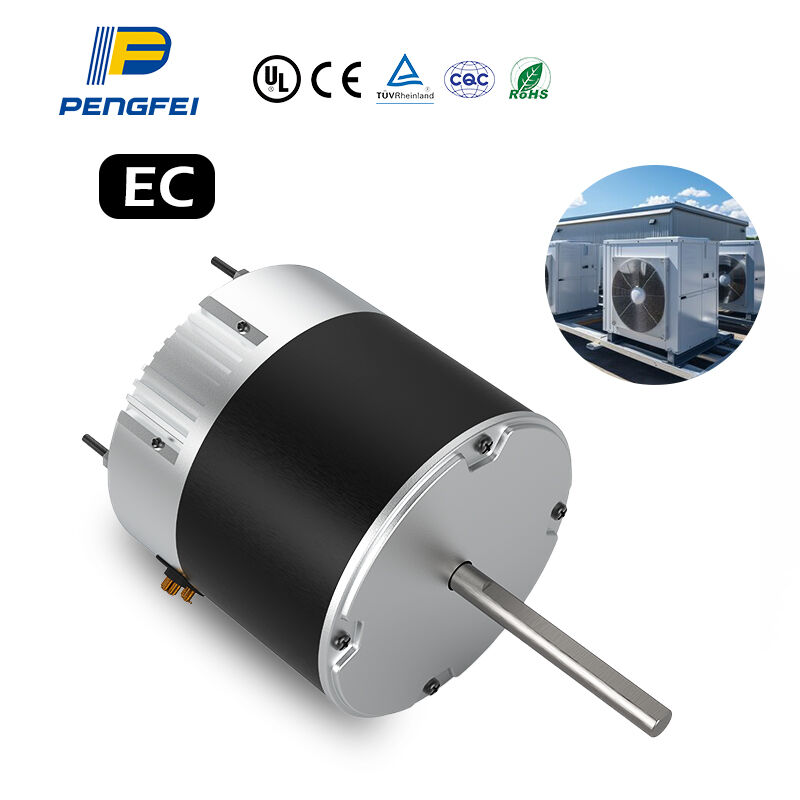
The Fundamental Principle Behind AC Fan Motor Operation
Electromagnetic Induction and Rotating Magnetic Field Generation
When alternating current passes through the stator windings, it creates a magnetic field that pulses back and forth. The frequency varies depending on location - typically 50 Hz across much of the globe, but 60 Hz in places like North America and some Asian countries. Copper coils are placed in specific positions around the motor to enhance this pulsing effect. What happens next is pretty clever: these coils generate what's known as a rotating magnetic field, even though nothing physically moves within the stator itself. And this rotating field? Well, that's basically how AC induction motors work their magic in countless industrial applications every day.
Inside this electromagnetic field sits what we call the rotor, usually made up of copper or aluminum bars arranged like a squirrel cage design with those conductive end rings connecting everything together. When the magnetic field rotates around these rotor conductors, something interesting happens according to Faraday's Law. Eddy currents start forming inside them. These currents create another magnetic field of their own, one that actually works against or with the original stator field depending on timing. That interaction creates the torque needed for motion. Now here's where things get really interesting: the rotor's magnetic field never quite catches up completely with the stator's field. This delay, which engineers refer to as slip, keeps the torque going continuously and allows the whole system to keep spinning round and round.
Energy Conversion: From AC Input to Mechanical Fan Rotation
When electricity flows through the motor, it creates this whole chain reaction of energy transformation. Alternating current turns into a spinning magnetic field which then induces currents in the rotor, ultimately producing mechanical torque. There's something called slip that keeps the rotor from catching up completely to the magnetic field. This actually helps generate the torque needed for the motor to work properly. Once the motor starts spinning, it needs to overcome both inertia and whatever load is attached. As the shaft spins faster, it either directly drives the fan blades or goes through pulleys depending on how the system is set up. Getting good airflow really comes down to two main things: making sure those blades are angled just right and keeping the motor running at a steady speed throughout operation.
Critically, this process requires no brushes, commutators, or external excitation—making AC fan motors inherently reliable, quiet, and well-suited for continuous-duty HVAC and industrial applications.
Key Internal Components of an AC Fan Motor and Their Functions
Stator Windings and the Role of the Capacitor in Starting Torque
A stator is basically made up of copper wires that are coated for insulation and placed inside a steel core that's been laminated. When we apply single phase alternating current to this setup, what happens is interesting but not exactly straightforward. The magnetic field created pulses back and forth, yet doesn't naturally want to rotate on its own. For getting things moving, many home appliances and smaller commercial motors rely on something called a capacitor start system. Here's how it works: there's a capacitor component that shifts the timing between two sets of windings (main and auxiliary), which tricks the motor into thinking it's dealing with almost two separate phases of electricity. This clever trick creates enough rotational force to get the motor spinning from a standstill.
This phase-shifted current allows the motor to self-start reliably. Without it, the motor would stall or merely vibrate (“hum”) under load. Capacitor-assisted designs remain dominant in residential HVAC due to their simplicity, cost-effectiveness, and proven reliability—powering approximately 87% of such units according to industry installation data.
Squirrel-Cage Rotor Design and Its Interaction with the Magnetic Field
The squirrel-cage rotor is a cylindrical assembly of parallel aluminum or copper bars embedded in and electrically shorted by two end rings. Its solid, brushless construction eliminates wear-prone components and supports thermal expansion without deformation.
As the stator’s rotating field sweeps past the rotor bars, it induces currents that generate a secondary magnetic field. The interaction between these fields produces Lorentz forces, resulting in rotational torque. Key advantages include:
- Maintenance-free operation (no brushes or slip rings)
- Self-regulating speed tied to supply frequency and load (via slip)
- High mechanical robustness and resistance to shock and vibration
This design underpins over 92% of industrial exhaust fans, as confirmed by 2023 HVAC efficiency benchmarking reports from the Air-Conditioning, Heating, and Refrigeration Institute (AHRI).
Why Single-Phase AC Fan Motors Dominate Residential and Light-Commercial Applications
Single-phase AC fan motors power more than 90% of residential HVAC systems and light-commercial equipment—not by accident, but because they deliver three decisive advantages.
First, they operate directly from standard 120/240V single-phase utility power, eliminating the need for costly three-phase service upgrades or phase-conversion hardware. This reduces installation complexity and lowers upfront costs by 30–50%.
Second, capacitor-start and permanent-split-capacitor (PSC) configurations provide dependable starting torque and stable low-speed operation—even under variable load conditions—while requiring minimal servicing. That reliability is essential for rooftop units, ducted air handlers, and other distributed equipment where access is limited.
Third, modern single-phase motors meet global energy standards—including IE2 (minimum efficiency level) and increasingly IE3—through optimized lamination stacks, precision-wound coils, and improved capacitor matching. Many achieve 92%+ efficiency in fan-specific duty cycles.
Manufacturers reinforce this dominance by designing standardized motor frames (e.g., NEMA 48–56) that integrate seamlessly across blower assemblies, control boards, and enclosure platforms—supporting scalable production and simplified aftermarket support.
Operational Benefits of AC Fan Motors for B2B Equipment Integration
Reliability, Low Maintenance, and Cost-Effective Scalability
AC fan motors are the preferred choice for B2B equipment integration due to their exceptional operational resilience. The brushless, commutator-free induction design enables rated lifespans exceeding 50,000 hours with negligible performance drift—translating to years of uninterrupted service in ventilation, cooling, and filtration systems.
Facility managers report up to 40% lower maintenance expenditures compared to brushed DC or universal motors, primarily due to eliminated brush replacement, reduced bearing wear, and fewer electrical failure modes.
From a manufacturing standpoint, the simplicity and modularity of single-phase AC induction motors allow identical platforms to be deployed across diverse product lines—from compact inline fans to large-capacity rooftop units—without retooling. This standardization supports IE2/IE3 efficiency compliance while reducing inventory overhead and accelerating time-to-market.
For enterprises managing multi-site operations, this scalability means unified procurement, simplified training, and faster spare-part fulfillment—ensuring continuity in mission-critical environments where downtime carries significant operational or regulatory risk.
FAQ
What is the role of the capacitor in AC fan motors?
In AC fan motors, capacitors are used to create a phase shift between two sets of windings, enabling the motor to start from a standstill and ensuring smooth running.
Why do single-phase AC fan motors dominate residential applications?
Single-phase AC fan motors are preferred in residential applications due to their compatibility with standard 120/240V power, reliable operation, and cost-effectiveness.
How does the squirrel-cage rotor contribute to the motor's efficiency?
The squirrel-cage rotor is robust and maintenance-free, allowing self-regulation of speed and resistance to wear and thermal expansion, which contributes to the motor's long-term efficiency.